
Your Nervous System Isn’t Designed for 24/7/365 Crisis
Tools to function inside a mad world.


For most of human history, danger was local and temporary.
A storm rolled in. A conflict broke out. A predator appeared.
Your body reacted, the situation resolved, and your nervous system stood down.
Even prolonged hardship had edges. War still had geography. Tragedy still had location. The brain could tell the difference between here and somewhere else, now and later, possible and present.
That boundary has quietly disappeared.
Today the human brain tracks a stream of threats that are global, continuous, and unresolved. Political instability, violence, economic uncertainty, institutional breakdown, environmental danger — not occasionally, but hourly. Delivered directly into the device we carry from the moment we wake up to the moment we fall asleep.
This is usually described as “more stress.”
It isn’t.
It is a different category of experience.
The Threshold We Crossed
The modern information environment does something evolution never prepared us for: it removes distance.
Your brain does not naturally distinguish between:
a threat happening nearby
a threat happening somewhere else
a threat that might happen
a threat that is merely discussed
The brain detects patterns and predicts survival relevance. When updates never stop, prediction never stops.
So the nervous system stays on.
Not because you’re weak.
Not because you’re pessimistic.
Because it believes monitoring is necessary.
People notice this in ordinary moments:
They check the news and feel worse but cannot disengage.
They feel dread during otherwise safe routines.
They feel exhausted despite no personal crisis.
They withdraw socially while wanting connection.
They feel responsible for events they cannot influence.
They cannot relax even when nothing is wrong.
These reactions look like anxiety and depression.
But look at the structure more closely.
They are monitoring behaviors.
Why This Resembles Trauma More Than Stress
Stress has a cycle:
Activation → action → resolution → recovery
Your body mobilizes, handles the situation, and stands down.
The current environment interrupts the last two steps.
You receive threat signals without resolution:
breaking developments
speculation
anticipation
escalation
reinterpretation
new developments
The brain never completes the loop.
Instead it shifts into continuous prediction mode — scanning, preparing, bracing.
That pattern is not ordinary stress exposure.
It matches the activation pattern seen in chronic threat conditions: persistent vigilance without closure.
No single event is overwhelming.
The absence of an ending is.
People often assume trauma requires a catastrophic personal experience. But at the nervous system level, what matters is repeated activation without recovery. When your brain cannot determine whether the situation has ended, it does not exit defensive processing.
The modern information stream behaves like an environment that never stabilizes.
So the mind does what it evolved to do: stay alert.
Why Traditional Advice Stops Working
Most coping advice assumes the brain believes the threat is optional.
But the brain currently treats monitoring as necessary.
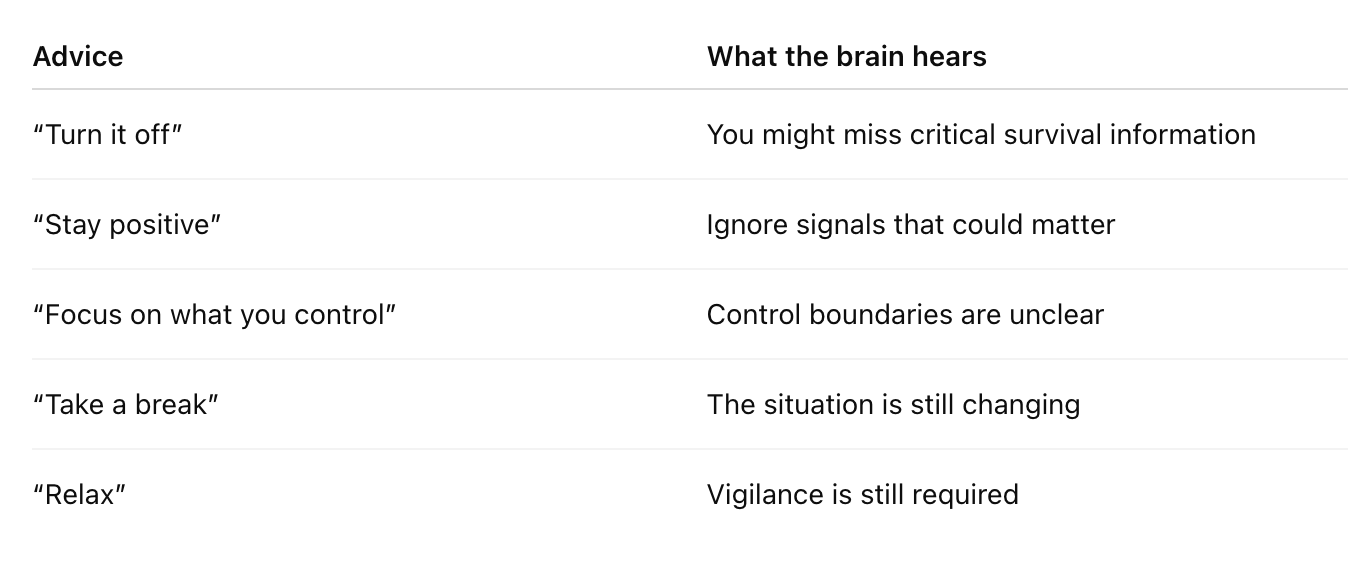
The result is a strange experience: people follow the advice and feel worse. Not calmer — guilty. As if they’re failing at something simple.
They’re not failing.
They’re using strategies designed for completed stress cycles in an environment where the cycle never completes.
The problem is misclassified.
What Actually Changed
Historically, the brain filtered danger by proximity.
Now danger is filtered by attention.
Attention has become exposure.
The human nervous system did not evolve to continuously evaluate abstract threat information affecting millions of people across distance and time. Yet that is now a normal daily activity.
We are asking our biology to do something unprecedented:
Remain informed about potential danger without treating it as immediate danger.
Without training, the brain collapses that distinction.
So people experience:
persistent background fear
anticipatory grief
emotional numbing
irritability
concentration problems
a sense that the future feels unstable
Not because reality is imagined, and not because it is fully personal — but because the brain cannot categorize ongoing uncertainty.
It defaults to preparation.
The New Required Skill
In earlier environments, emotional regulation meant calming down after something happened.
Now it means managing input while it is happening.
This is a different ability.
The challenge is no longer simply coping with feelings.
It is regulating how information becomes physiological activation.
You cannot solve this by ignoring reality.
You also cannot solve it by continuously absorbing reality.
The modern world requires a skill humans never previously needed:
to remain informed without remaining activated.
That does not occur automatically.
It must be learned deliberately, the same way literacy once had to be learned after written language emerged. Reading changed human cognition; information streams now change emotional processing.
Without training, attention equals exposure.
With training, attention becomes selective awareness.
A Shift in What Support Means
Traditionally, emotional help was framed as repairing distress after it appeared — therapy for symptoms.
But the environment now produces activation before individual problems exist. The distress is not always personal; it is systemic input interacting with human physiology.
So the role changes.
Not fixing broken people.
Teaching people how to operate inside a new psychological landscape.
Emotional regulation coaching, in this context, is less like treatment and more like adaptation training — learning how to:
distinguish signal from immersion
complete stress cycles intentionally
prevent anticipation from becoming continuous alarm
re-establish internal boundaries when external boundaries vanish
The goal is not constant calmness.
The goal is accurate activation.
Feeling fear when something affects your life is healthy.
Feeling fear constantly because everything might affect your life is unsustainable.
The Best Defense: Emotional Regulation Skills
The increase in anxiety and exhaustion people report is often interpreted as a decline in resilience.
Another explanation fits better.
The human nervous system evolved for direct, time-limited danger.
The modern world delivers indirect, continuous danger information.
Without new skills, the brain treats information as immediate threat.
So it never powers down.
What many people are experiencing is not simply more stress.
It is living in an environment where the off-switch no longer occurs on its own.
Learning how to create that off-switch deliberately is becoming a basic life skill — not to feel happier, but to remain functional inside a permanently updating world.